GED Classes: Online, Free, and In-Person Options for 2026
GED classes can give you instruction, structure, and accountability, but the best choice depends on your schedule, starting skills, budget, and location. This guide compares online, in-person, free, and paid options so you can find useful support without confusing a preparation class with the official GED test.

Quick Answer: Which GED Classes Should You Choose?
Choose the class format you can attend consistently and that gives you feedback on the subjects you actually need. Online GED classes are useful when work, transportation, or family responsibilities make a fixed classroom difficult. In-person classes can be a better fit when you want a teacher nearby, scheduled practice, or help staying accountable. Free programs may lower preparation costs, but eligibility, attendance, materials, and testing fees can still vary. Before paying or enrolling, check the program schedule and compare its support with your own diagnostic practice results.
What Are GED Classes?
GED classes are preparation programs that help adults review the four GED subject areas: Mathematical Reasoning, Reasoning Through Language Arts, Science, and Social Studies. A class may include lessons, guided practice, teacher explanations, homework, study schedules, or referrals to testing resources. It does not issue the GED credential. You still need to meet the current rules for your state or jurisdiction and schedule the official tests through the approved process.
Programs may cover all four subjects, one subject, or a narrow skills workshop. Ask what is included before assuming that “GED prep” means a complete course; practice questions without individual feedback may not solve your main gap.
Use the official GED website to verify current eligibility, test subjects, scheduling, accommodations, and record information. If a learner needs support on the official exam, use the GED testing accommodations guide to separate classroom help from the official request process. The class helps you prepare; the official source remains the authority for rules that can vary by location.
Online GED Classes vs In-Person Classes
The format matters less than the support you will use every week. Compare the practical trade-offs before choosing a provider or community program.
| Option | Often works well when you need | Check before enrolling |
|---|---|---|
| Online live class | Flexible location with a scheduled teacher and real-time questions. | Meeting times, camera or internet requirements, recordings, and attendance rules. |
| Online self-paced course | Control over study time and the ability to repeat lessons. | Feedback quality, deadline structure, support response time, and refund terms. |
| In-person class | Direct explanation, a routine, peer support, and fewer home distractions. | Travel time, class size, subject coverage, make-up policy, and accessibility. |
| Hybrid program | A combination of classroom help and independent review. | Which sessions are mandatory, how online work is tracked, and who provides feedback. |
Online does not automatically mean easier, and in-person does not automatically mean more complete. Choose the format that matches your real week and gives you feedback, not the format that sounds best in a course description.
How to Find GED Classes Near Me
Search results for “GED classes near me” often mix official resources, adult education centers, community colleges, libraries, nonprofit programs, and commercial courses. Use a short verification process so you can tell a real preparation option from a page that only sells a book or collects your contact information.
- Start with the official route. Use the official GED site and your state or local adult education agency to identify recognized preparation resources and current testing rules.
- Search local education providers. Check community colleges, adult schools, libraries, workforce centers, and nonprofit organizations. Look for a complete address or service area, a current contact method, and a visible class schedule.
- Confirm the subject coverage. Ask whether the program teaches all four GED subjects or only one area. If you already know that math is your weak subject, a broad course may not be enough without targeted practice.
- Ask about assessment. A useful class should explain how it identifies your starting point, tracks missed skills, and decides when you are ready for timed practice. “Unlimited access” is not the same as feedback.
- Verify the next step. Confirm the enrollment process, attendance expectations, cost, materials, accommodations, and whether the program helps with preparation only or also explains how to schedule the official test.
If a listing has no recent schedule or clear contact method, treat it as a lead rather than proof that the class is active.
Free GED Classes: What “Free” Usually Means
Free GED classes may be funded by adult education programs, nonprofits, libraries, workforce programs, or community organizations. “Free” may cover instruction but not books, tutoring, placement, platform access, or the official testing fee.
Before enrolling, ask whether tuition is free for you, what materials are included, whether attendance is required, and which practice or testing costs remain separate.
Important: Free preparation does not automatically mean a free official GED test. State, jurisdiction, subject, retake, and readiness costs can vary. Use the site's GED test cost guide as a planning checklist, then confirm the current amount with the official source for your location.
GED Class Cost and Schedule Questions
There is no single national price for GED classes. Cost depends on the provider, format, number of subjects, access length, tutoring, materials, and local funding. A lower price is not useful if the course has no feedback or conflicts with your work.
| Before you compare price | What to confirm |
|---|---|
| Instruction | Teacher access, feedback, and subject-specific help. |
| Access | Course length, recordings, deadlines, and access after the course ends. |
| Materials | Books, practice questions, worksheets, and platform fees. |
| Support | Placement checks, progress reviews, accommodations, and next-step guidance. |
Record the full weekly commitment, travel or technology needs, and testing deadlines before deciding. A shorter program you can attend consistently is often more useful than a long class you repeatedly miss.
How to Choose a Class by Your Starting Point
If you are rebuilding the basics
Look for slower instruction, teacher feedback, and a clear path for reading, number sense, fractions, algebra, graphs, and basic writing. Avoid choosing a fast review course just because it says “complete GED prep.”
If you are close to passing
Choose targeted support rather than repeating every lesson. Ask whether the program can diagnose missed skills, explain errors, and focus on one subject or narrow skill group.
If work or family controls your schedule
Prioritize predictable access and a realistic weekly plan. If you choose recordings, set fixed study appointments and a weekly review date so “flexible” does not become “never scheduled.”
Questions to Ask Before Enrolling
- Which GED subjects and skill levels does the class cover?
- How is a learner's starting level assessed?
- Who answers questions, and how quickly can students get feedback?
- What is the total cost after tuition, materials, platform access, and optional tutoring?
- Are classes live, recorded, self-paced, or hybrid?
- What attendance, technology, transportation, or accommodation requirements apply?
- How does the class recommend moving from lessons to timed practice and official scheduling?
Combine GED Classes with Practice Tests
A class gives you instruction; practice gives you evidence. Use both in a simple loop instead of waiting until the end of a course to discover that one subject still needs work.
| Study point | Useful action | What to record |
|---|---|---|
| Start | Take a short diagnostic or subject practice set before choosing extra support. | Topics missed, timing problems, and questions you guessed on. |
| During class | Bring two or three missed-question examples to the teacher or study group. | The mistake type and the correction method, not just the final answer. |
| After review | Repeat a timed practice set and compare performance by subject. | Accuracy, pacing, repeated errors, and whether the skill transfers. |
Begin with the site's free GED practice tests and the GED test subjects guide. Use the GED study guide for a weekly plan, then review the GED test score range and official readiness rules before scheduling.
GED Classes FAQ
Bottom Line
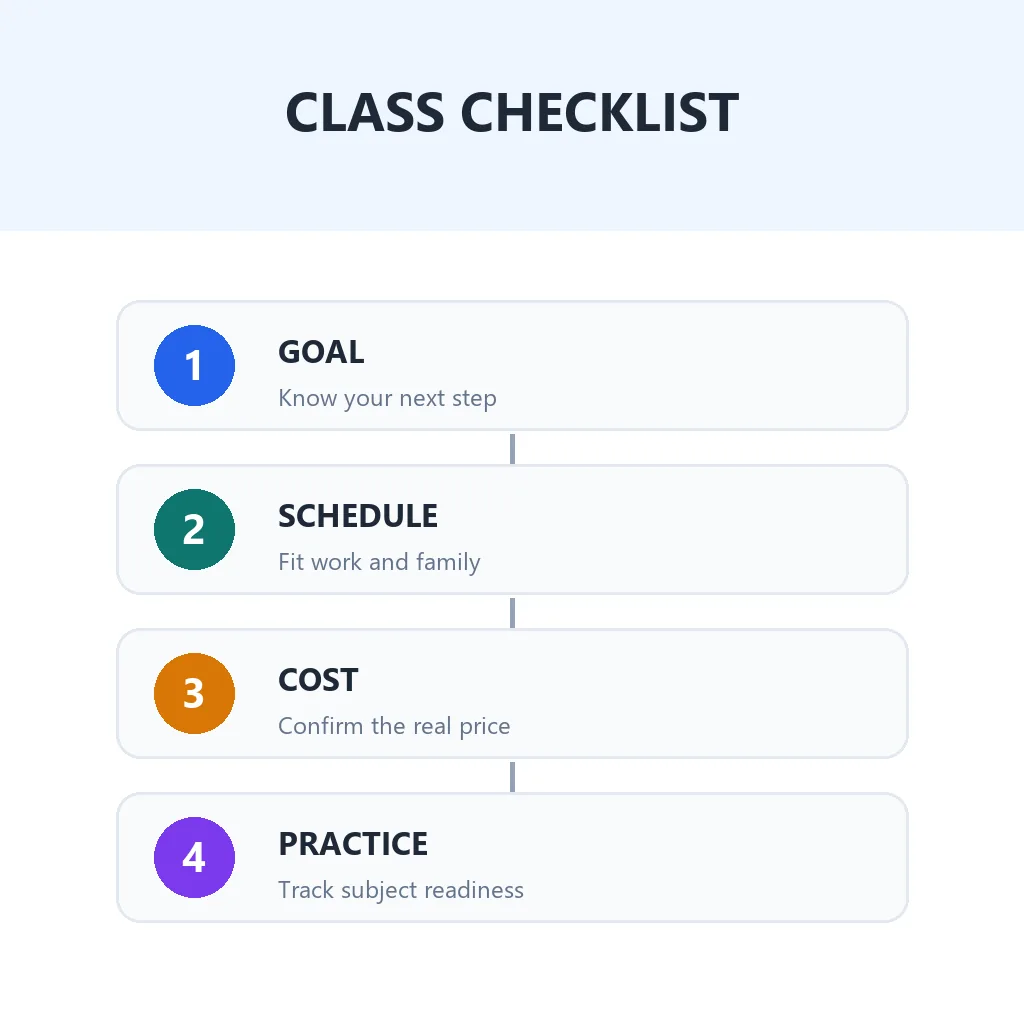
Good GED classes are practical support, not a shortcut. Compare the format, teacher access, schedule, total cost, and subject coverage. Use your own practice results to decide where help is worth paying for, and verify current eligibility and testing rules through the official GED source. A consistent class plus focused practice is usually more valuable than a course that looks comprehensive but does not fit your real week.
Sources to Verify Current GED Class and Testing Details
This guide was reviewed on September 6, 2026. Class schedules, funding, prices, eligibility, and testing policies can change. Verify current details with the official GED Testing Service and your local adult education provider before enrolling or scheduling an exam.
Class Choice Shortcuts
A Practical Enrollment Test
Before paying, write down the weekly class time, travel or technology needs, full cost, and the exact subject support included. If the plan does not fit your actual week, keep looking.