GED practice-test timing guide
How Long Is the GED Practice Test? Timing Guide by Subject
If you are asking how long is the GED practice test, the useful answer is not one number. A short diagnostic, a subject simulation, and a full timed rehearsal serve different purposes. Choose a length that measures the skill you want to improve, then leave time to review the mistakes.
GED classes planning note: use a short timed block during class or homework, then schedule a longer subject simulation when you need a clearer readiness signal. Keep the review step in the lesson plan so the score leads to a specific next skill.
Quick answer: how long should you practice?
Use 10–30 minutes for a quick diagnostic, 45–90 minutes for a focused subject session, and an official-subject-length simulation when you are training stamina. A full four-subject rehearsal is best treated as a late-stage check, not the default study session. The right length is long enough to reveal pacing problems but short enough that you can still review why you missed questions. In a GED class, the shorter format usually fits a lesson better; reserve a subject-length simulation for a planned assessment block.

How Long Is the GED Practice Test by Format?
“GED practice test” can describe several different experiences. A page with ten questions is useful for checking one skill, but it cannot tell you whether you can stay focused for a long Reasoning Through Language Arts session. A full-length simulation is better for stamina, but it may be inefficient if you still need to learn the basics.
Use the table below as a planning range rather than a promise from every provider. The exact number of questions, timer behavior, explanations, and pause rules vary. If a platform is untimed, you can add your own clock for a more realistic rehearsal.
| Practice format | Useful time range | Best question it answers |
|---|---|---|
| Quick diagnostic | 10–30 minutes | Which subject or skill should I study first? |
| Focused subject set | 30–60 minutes | Can I apply one skill without needing a long warm-up? |
| Subject simulation | 45–90 minutes or the target subject limit | Can I maintain accuracy and pace in one subject? |
| Full timed rehearsal | One subject at a time, or several blocks across a day | Does fatigue or switching subjects change my performance? |
Use official GED subject times as pacing benchmarks
The official GED exam is divided into four subject tests, so practice timing should eventually reflect the subject you plan to take. These are exam benchmarks, not a rule that every free practice page must use the same timer. A short online quiz can still be useful when your goal is accuracy or topic diagnosis. Teachers can use the benchmarks to plan a longer mock session without forcing every class meeting to run like an exam appointment.
| Subject | Planning benchmark | What to rehearse |
|---|---|---|
| Reasoning Through Language Arts | 150 minutes | Reading, editing, extended response, and sustained focus |
| Mathematical Reasoning | 115 minutes | Problem setup, calculator decisions, checking, and steady pace |
| Science | 90 minutes | Reading experiments, tables, graphs, and evidence |
| Social Studies | 70 minutes | Source reading, claims, charts, and eliminating distractors |
For a broader explanation of official test length, breaks, and subject scheduling, see the GED test time guide and the GED test subjects overview. The live rules, appointment instructions, and current product details belong to GED.com.
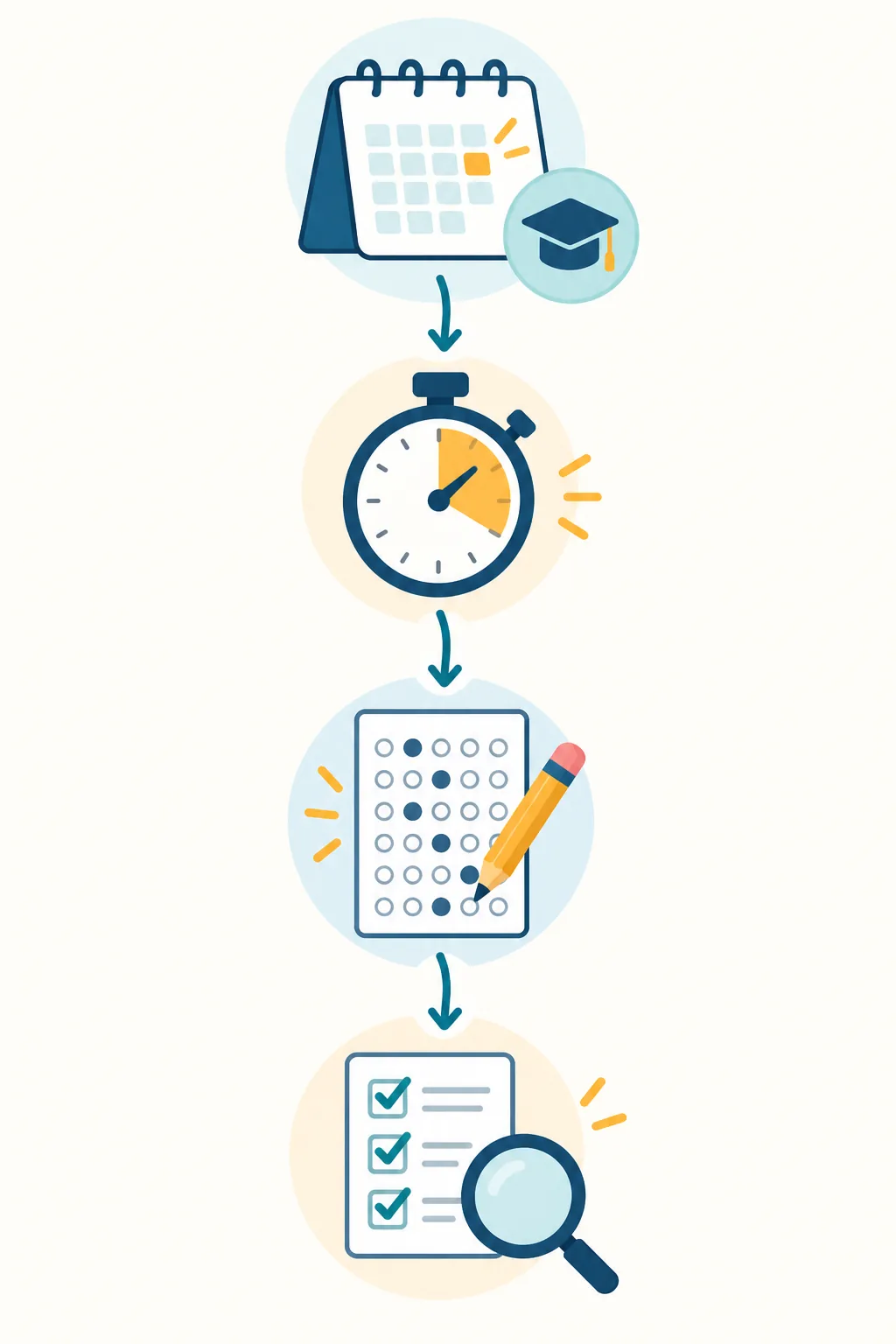
A practical timed GED practice-test session
When you want a realistic result, the timer is only one part of the session. Use the same calculator, scratch-work habits, reading environment, and break plan that you expect to use later. Then record what happened instead of looking only at the final percentage. For a class, write the start time, stop time, and review target on the assignment sheet so students can compare pacing without guessing.
- Choose one measurement goal. Decide whether you are measuring accuracy, question speed, stamina, or readiness in one subject. A session that tries to measure everything usually produces a vague result.
- Set the time before you start. Use the platform timer if it is reliable. If the practice page is untimed, use a separate clock and write down your start and stop time.
- Mark uncertainty without stopping. If you are stuck, flag the question and move on. Timing practice should show whether you can protect time for questions you can answer.
- Finish the planned block. Do not end a subject simulation early just because the first questions feel difficult. The later minutes are often where fatigue and careless reading appear.
- Review the reason for each miss. Label misses as content, reading, calculation, careless error, or pacing. Your next study block should respond to that pattern.
How long to practice each GED subject
Math: build from short blocks to the full benchmark
Math practice often works best in layers. Start with 20–30 minutes of algebra, geometry, data, or word-problem questions. When you can set up problems reliably, move to a 45–60 minute mixed block. Near the end of your preparation, use one longer session that approaches the 115-minute Math benchmark. Review whether time was lost on arithmetic, reading, calculator choices, or deciding how to start.
RLA: practice reading and writing stamina separately first
RLA is difficult to simulate with a short grammar quiz. Use a reading block, an editing block, and an extended-response block before combining them. For example, you might spend 25 minutes on passages, 25 minutes on language questions, and 35–45 minutes on writing and revision. Later, work toward a longer session that resembles the 150-minute exam benchmark. The GED RLA study guide and GED essay practice page can help you isolate the part that slows you down.
Science: spend time on data, not only facts
A 30–45 minute Science set can reveal whether you understand graphs, experiments, variables, and evidence. Increase the session toward 60–90 minutes when your content knowledge is stable. If the score drops late in the session, practice reading the question stem and table before adding more memorization.
Social Studies: rehearse source reading under a shorter clock
Social Studies has a shorter planning benchmark, but the reading still demands attention. Try a 30–40 minute set with passages, charts, and historical or civic sources. Then use a 70-minute simulation to see whether you can keep eliminating unsupported answers after the first rush of questions.
Do not skip review. A 60-minute practice test followed by no analysis is usually less useful than a 40-minute test followed by 30 minutes of careful review. The goal is to learn why your pace changed and what to do in the next session.
How much review time should you add?
Reserve at least 20–40 minutes after a short or subject session. After a long rehearsal, you may need another study block to review every missed or guessed question. Read the explanation, write the rule or reasoning in your own words, and redo the problem without looking. If you cannot explain the answer, the timed score is not yet a useful readiness signal.
Review time also helps you decide whether to lengthen the next test. If accuracy is strong but you ran out of time, keep the content level similar and add pacing work. If you finished quickly with many content misses, taking a longer test will not fix the underlying gap. Return to a focused free GED practice test, then use results analysis to organize the next step.
When should you take a full timed practice test?
Use a full timed rehearsal after you know the main question types and have completed at least one round of subject review. It is most useful when you can finish a subject block without guessing on every final question, your environment is stable, and you are ready to compare stamina across subjects. If you are still learning basic formulas or how to read a data table, a shorter session will give you faster feedback.
- Take one subject at a time while you are diagnosing weaknesses.
- Use a longer subject simulation when your accuracy is stable.
- Use a mixed or full rehearsal near the end to check fatigue and transitions.
- Repeat the review process before scheduling an official subject test.
GED practice test timing FAQ
Bottom line
The answer to how long is the GED practice test depends on what you are trying to learn. Start with a short diagnostic when you need direction, use a subject-length session to train pace, and reserve a full timed rehearsal for stamina and final preparation. Always protect time for reviewing missed questions. The best practice length is the one that gives you a clear next action rather than only a score.
Sources for current GED timing details
Practice platforms can change their question count, timer, and pause behavior. For current official eligibility, GED Ready details, subject timing, accommodations, and scheduling, verify the final information through the official GED study guide, the GED test-time reference, and your GED.com account.
Timing Shortcuts
A Simple Rule
Do not make every study session a full exam. Use short practice to learn, subject simulations to pace, and one longer rehearsal to check stamina.