GED Science Study Guide2026 Topics,Examples, and Study Plan
Use this GED Science study guide to focus on the skills that matter most: reading science passages, interpreting charts, understanding experiments, and applying basic concepts from life science, physical science, and earth and space science.
Quick Answer: What to Study for GED Science
Study the three content areas, but spend most of your time practicing how to use evidence. The GED Science test commonly asks you to read a short passage, inspect a table or graph, identify variables in an experiment, compare claims, and choose the answer supported by the data. A strong study plan combines topic review with timed GED Science practice questions. For a full four-subject schedule, start with the GED study guide and then return to this science page for focused review.
GED Science Test Topics at a Glance
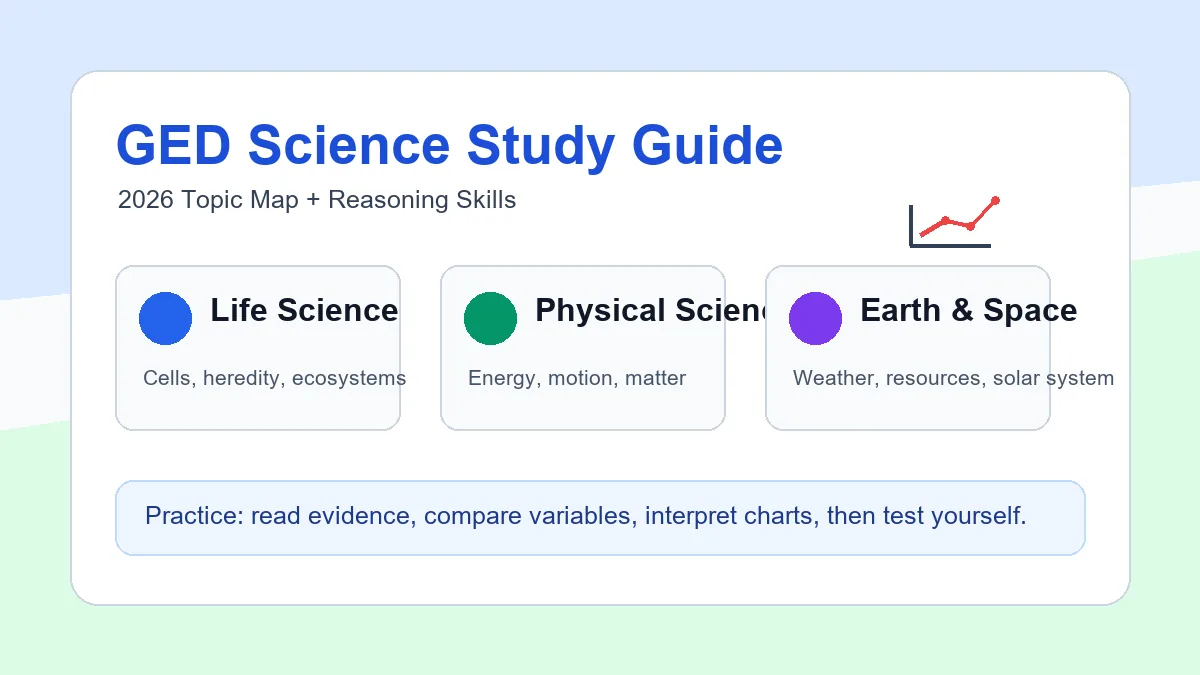
The official GED Science subject covers life science, physical science, and earth and space science. GED also emphasizes two broad themes: human health and living systems, plus energy and related systems. Use the table below as your study map, then test each area with short quizzes.
| Content Area | Approximate Weight | What to Review | Practice Skill |
|---|---|---|---|
| Life Science | About 40% | Cells, body systems, genetics, ecosystems, evolution, health, and heredity. | Connect a process or claim to evidence in a passage. |
| Physical Science | About 40% | Atoms, chemical reactions, energy, motion, force, electricity, and basic physics. | Use simple formulas, units, and data trends without overcalculating. |
| Earth and Space Science | About 20% | Weather, climate, natural resources, fossils, geology, the solar system, and Earth systems. | Read diagrams, maps, and cause-and-effect explanations. |
1. Life Science Study Guide
Life science questions often look like reading questions with scientific vocabulary. You may see a passage about a body system, a food web, a genetic trait, or an environmental change. Your job is usually to identify the evidence that supports a conclusion, predict what happens next, or match a term to a process described in the question.
High-value life science topics
- Cells and body systems: know that cells form tissues, tissues form organs, and organs work in systems such as digestion, circulation, and respiration.
- Genetics and heredity: understand inherited traits, dominant and recessive patterns at a basic level, and how offspring can vary.
- Ecosystems: review producers, consumers, decomposers, food chains, competition, and how a population change affects the system.
- Evolution and adaptation: focus on how traits can help organisms survive in a specific environment.
Example: Evidence-Based Life Science Question
Scenario: A table shows that plants receiving 8 hours of light grew taller than plants receiving 2 hours of light. Which conclusion is best supported?
Best approach: Do not choose the broadest claim. Choose the answer limited to the data: in this experiment, more light was associated with more plant growth. Avoid answers that add soil, temperature, or plant species if those variables were not tested.
2. Physical Science Study Guide
Physical science can feel intimidating, but GED questions usually provide the information you need. You should recognize common ideas such as force, motion, energy transfer, states of matter, atoms, and chemical changes. The harder part is often reading the graph or identifying the relationship between two variables.
Physical science concepts to know
- Motion and force: speed compares distance and time; force can change the motion of an object.
- Energy: energy can transfer or change form, such as chemical energy becoming thermal energy.
- Matter: atoms make up matter, and physical changes differ from chemical reactions.
- Electricity and waves: review simple cause-and-effect relationships instead of memorizing advanced formulas.
3. Earth and Space Science Study Guide
Earth and space science is a smaller share of the test, but it is easy to improve with focused review. Learn the difference between weather and climate, how natural resources connect to human activity, how fossils support scientific explanations, and how the sun, moon, planets, and Earth systems interact.
Practice reading temperature, rainfall, pressure, and climate trend graphs.
Know renewable vs. nonrenewable resources and how evidence supports environmental claims.
Review gravity, orbits, moon phases, seasons, and the solar system at a practical level.
Scientific Reasoning Skills You Must Practice
Many GED Science questions are not asking, "Do you remember this fact?" They are asking, "Can you reason from the evidence?" Build these skills every time you review a question.
- Find the claim. Identify what the question is trying to prove, explain, or compare.
- Read the labels. Check graph titles, units, axes, table headings, and answer-choice wording.
- Separate variables. In experiments, identify the independent variable, dependent variable, and controlled variables.
- Use only the evidence given. Avoid outside assumptions unless the question asks for background knowledge.
- Check direction and size. Notice whether a trend increases, decreases, stays constant, or changes sharply.
Experiment Design Cheat Sheet
| Term | Meaning | GED Clue |
|---|---|---|
| Independent variable | What the experiment changes on purpose. | "Group A received..." or "The researcher changed..." |
| Dependent variable | What is measured as the result. | "The amount produced," "growth measured," or "time recorded." |
| Control | The comparison condition or unchanged setup. | A group that does not receive the treatment. |
| Controlled variables | Things kept the same to make the test fair. | Same temperature, same time, same amount, same material. |
7-Day GED Science Study Plan
If your test date is close, use a short plan that mixes content review with timed practice. If you have more time, repeat the cycle and spend extra days on your lowest-scoring area.
| Day | Focus | Task |
|---|---|---|
| Day 1 | Diagnostic | Take a 15-20 question science quiz and list every missed skill. |
| Day 2 | Life Science | Review body systems, genetics, ecosystems, and evidence questions. |
| Day 3 | Physical Science | Practice energy, force, motion, matter, and unit-based questions. |
| Day 4 | Earth and Space | Review weather, climate, resources, fossils, and solar system diagrams. |
| Day 5 | Graphs and Tables | Answer only chart, graph, and table questions; write why each answer is supported. |
| Day 6 | Experiments | Drill variables, controls, hypothesis, conclusion, and fair-test questions. |
| Day 7 | Timed Review | Take a timed GED Science practice test, then review explanations before retesting weak areas. |
Common GED Science Mistakes
- Memorizing facts without practicing questions: content helps, but the test mainly rewards reasoning from passages and data.
- Ignoring units: a graph may use minutes, seconds, grams, milliliters, Celsius, or percentages. Units often decide the answer.
- Choosing answers that sound scientific: the correct answer must match the evidence, not just use science vocabulary.
- Reading the graph too quickly: always check axes, labels, and whether the question asks for highest, lowest, greatest change, or best conclusion.
- Skipping review after practice: the score matters less than the pattern of missed skills.
FAQ
Next Step
After reviewing this guide, take a timed science quiz and compare your missed questions against the sections above. If most mistakes are graph or experiment questions, review the reasoning skills before adding more content memorization.
Study Links
- GED Science Practice Test
- 15-Question Science Quiz
- Full GED Practice Test
- Printable GED Practice Test PDF
- Official GED Science Overview
Primary Keyword
GED Science study guide
Best Use
Review this page before practice, then return after each quiz to target your weakest section.