GED vs HiSET: How to Choose the Right Equivalency Test
GED vs HiSET is first a state-availability question. Both are high-school-equivalency exam programs, but they have different test structures and may have different delivery options, score rules, fees, and retake policies where you live. Check your state’s current approved options before you compare anything else.
A useful GED vs HiSET comparison starts with the exam rules that apply to your state, not with a universal ranking of difficulty.
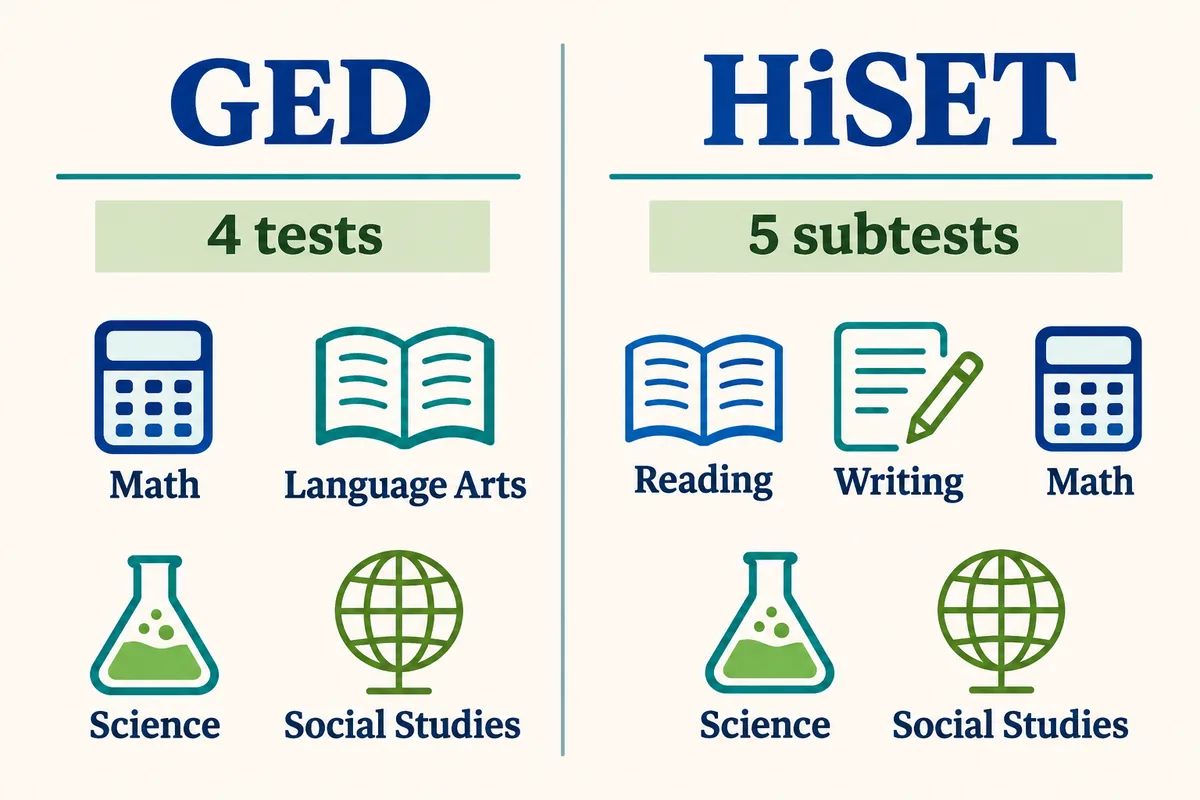
GED vs HiSET: At a Glance
Use this table to identify what you need to verify. Program details can vary by state and can change, so treat it as a comparison framework rather than a substitute for current registration rules.
| Decision point | GED | HiSET |
|---|---|---|
| Test structure | Four separate subject tests: Mathematical Reasoning, Reasoning Through Language Arts, Science, and Social Studies. | Five subtests: Mathematics, Language Arts Reading, Language Arts Writing, Science, and Social Studies. |
| Delivery format | Official materials describe a computer-based exam. Check whether your state offers an approved test-center or online-proctored appointment. | Available formats depend on state and location. Some state programs list paper and computer testing at centers, with separate rules for at-home exams. |
| Credential rules | Your state sets eligibility, passing requirements, and how the credential is awarded. | Your state sets eligibility, passing requirements, and how the credential is awarded. |
| Score reporting | Uses the GED score scale and official passing rules. | Uses a separate HiSET score scale and official passing rules. |
| Price and retakes | Fees can vary by state, delivery method, subject, and retake rule. | Fees can vary by state, delivery method, subject, and retake rule. |
| Availability | Confirm that the GED is an approved option for your location and eligibility category. | Confirm that the HiSET is an approved option for your location and eligibility category. |
Why the state check matters: state education agencies can approve different exams and set local conditions. Colorado, for example, lists both GED and HiSET as approved tests and publishes its own format and fee details. That Colorado example should not be applied to another state.
For a GED vs HiSET decision, reopen the official state page close to registration so your notes match the current approved tests and appointment options.
Four GED Tests vs Five HiSET Subtests
The GED groups language arts into one subject test called Reasoning Through Language Arts. HiSET separates language arts into Reading and Writing subtests. Both programs also assess mathematics, science, and social studies. That difference affects how you organize a study plan and schedule appointments, but the number of tests alone does not measure the work required.
The GED vs HiSET subject difference matters when you plan study sessions: a learner can track HiSET Reading and Writing separately, while GED language arts preparation stays within one subject test.
For GED preparation, you can review the four GED test subjects and their timing. For HiSET preparation, read the official test outline for the content and format used by your state. Do not assume that a familiar subject name means the questions, timing, or score scale are identical.
If you already have a stronger reading score than writing score, a separate HiSET Reading and Writing result may help you see those areas individually. If you prefer to keep language arts together, the GED structure may feel easier to plan around. These are study-planning preferences, not evidence that either test is easier to pass.
Format, Score Rules, and Accommodations
Test format can affect your decision if you prefer paper, have limited access to a computer, need a test center nearby, or are considering an online appointment. GED official subject information describes computer-based testing. A state’s HiSET page may list paper or computer appointments at a center, and online testing may use a different set of requirements. Confirm the delivery method on the official state page before you make a plan.
Scores are not interchangeable. Each provider reports results on its own scale and publishes its own passing guidance. Compare a GED practice result only with current GED guidance, and compare a HiSET practice result only with current HiSET guidance. If a college, employer, apprenticeship, or licensing program has a minimum score or transcript rule, ask that organization which exam and score report it accepts.
Ask about accommodations before booking. The request process, documentation, deadlines, and approved testing format may be different for each provider. Start with the provider’s official accommodation instructions and your state’s testing page, then keep confirmation of any approved arrangement. If you need a disability accommodation, do not rely on an informal description of what a test center usually allows.
How to Choose Between GED and HiSET
Work through these checks in order. They turn a broad GED or HiSET comparison into a decision you can verify for your own location.
1. Find the state-approved tests
Use your state education agency’s high-school-equivalency page. Record which exam programs are currently accepted, the age and enrollment rules, and the link used for registration. If only one exam is available to you, the comparison ends there unless your state office confirms an exception.
2. Check the format you can actually take
Compare test-center distance, computer or paper options, online-proctor rules, identification requirements, technology checks, and appointment availability. A format listed by the national provider may not be offered in every state or at every center.
3. Compare the full cost and retake policy
Add every subject or subtest, state and center fees, online-proctor charges, and any required practice or readiness test. Then check how many retakes are allowed, whether a waiting period applies, and whether the retake price changes. For GED fee planning, see our GED test cost guide; confirm the current numbers with your state before paying.
4. Check the institution that matters to you
If you are choosing for a college, job, training program, or license, ask that destination whether it accepts the state-issued credential and which score or record it needs. Keep the answer with your application notes rather than relying on a general claim that every destination treats both tests the same.
Two practical examples
Example A: A learner can reach a test center for either exam, but their state’s current page lists only one as approved for their age group. They should confirm eligibility for that approved option, then plan study time around its subject structure. Choosing a test because an older comparison article lists it would create avoidable registration risk.
Example B: A learner has a strong reading foundation, wants separate reading and writing results, and is considering HiSET. They should first verify that HiSET is available where they live, then use its official materials to review both subtests. A GED practice score cannot predict a HiSET result because the tests and score scales differ.
If your main concern is preparation time rather than exam choice, use the GED study guide to make a subject-by-subject plan, or compare GED class schedules and formats. Those resources address preparation; this page addresses which exam program to verify.
Common Mistakes When Comparing the Exams
- Choosing by test count. Four versus five sections describes the structure, not the difficulty or total study hours.
- Assuming every state offers both. Approval, age rules, formats, and locations are local decisions. Recheck them before registering.
- Copying a fee from another state. State, center, online, and retake charges can be different. Use the price shown for your own appointment.
- Comparing unlike scores. Each provider’s scale has its own meaning. Use the matching official score guide.
- Relying on old comparison tables. Test delivery, fees, and provider processes can change. Check the page date and follow the current official link.
Once you confirm your exam, make the next step small: review its official subject outline, take a short diagnostic, and choose one weak area to practice. If you are preparing for the GED, our free GED practice tests can help you find a starting point. For location or appointment questions, use the GED testing location guide and verify the final details in your state account.
GED vs HiSET FAQ
Official Sources to Check
- GED official test subjects and format - current GED subject structure and test details.
- HiSET official test-taker information - start with the provider's current registration guidance.
- Colorado Department of Education high-school-equivalency comparison - a state-specific example of approved exams, formats, and fees; use your own state's page for local rules.
This guide compares program structure and points to official rules. It is not a guarantee of eligibility, state availability, cost, admission, or a particular test result.