GED Social Studies Study Guide 2026: Topics, Examples, and 7-Day Plan
Use this GED Social Studies study guide to focus on the skills that matter most: reading historical and civic passages, identifying claims and evidence, interpreting maps and graphs, and applying basic civics, economics, geography, and U.S. history concepts.
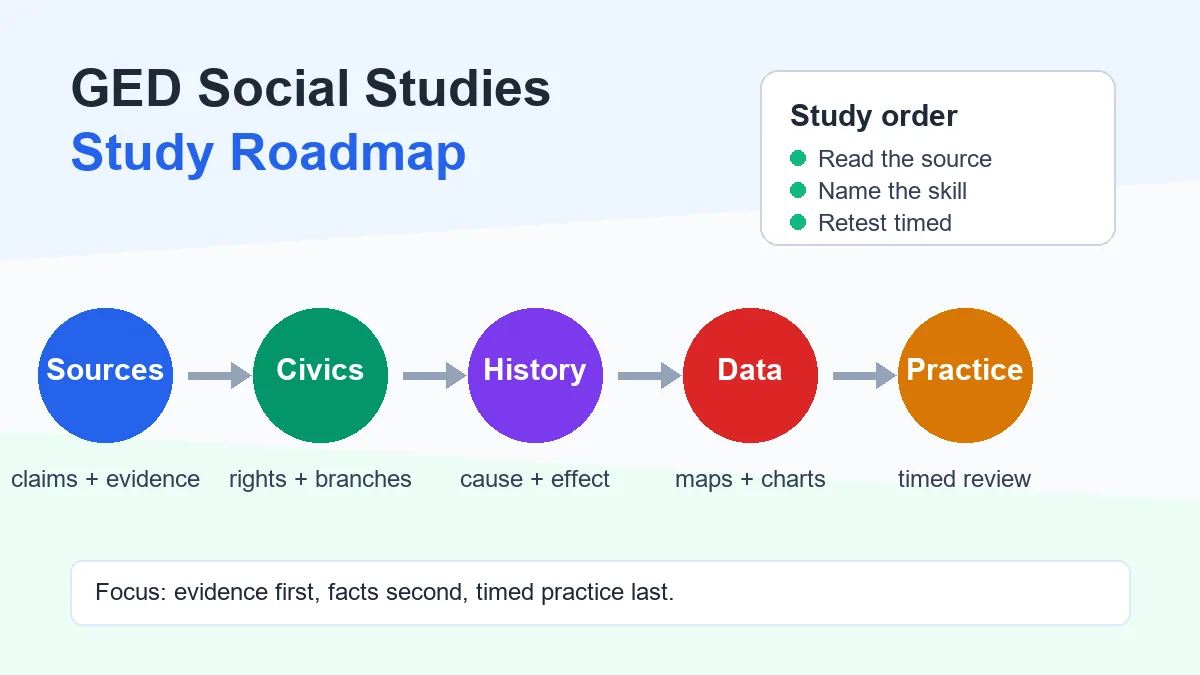
Quick Answer: What to Study for GED Social Studies
Study the content areas, but spend most practice time on social studies reasoning. The official GED Social Studies test emphasizes reading for meaning, analyzing historical events and arguments, and using numbers and graphs in social studies. That means you should practice finding a claim, matching it to evidence, noticing bias or point of view, reading charts, and applying basic civics, history, economics, and geography knowledge. Use this guide for focused review, then confirm readiness with the GED Social Studies practice test.
GED Social Studies Test Topics at a Glance
The Social Studies test is not a trivia exam. You still need background knowledge, but most questions ask you to reason from a passage, map, timeline, political cartoon, chart, or short historical source. Use the table below to decide what to review first.
| Study Area | What to Review | Practice Skill | Common Question Clue |
|---|---|---|---|
| Civics and Government | Branches of government, Constitution basics, rights, citizenship, elections, and federalism. | Connect a rule or principle to a civic example. | Words such as amendment, separation of powers, checks and balances, or due process. |
| U.S. History | Founding documents, major conflicts, reform movements, civil rights, and broad cause-and-effect patterns. | Analyze why an event happened or what changed after it. | A timeline, primary-source excerpt, speech, or historical claim. |
| Economics | Supply and demand, opportunity cost, markets, taxes, labor, inflation, and basic personal finance terms. | Read a simple graph and explain a tradeoff. | Price, scarcity, wages, budget, consumer, producer, or unemployment. |
| Geography and World History | Maps, regions, migration, resources, population, borders, and broad global patterns. | Use location, scale, or map symbols to support an answer. | A map, migration pattern, resource chart, or regional comparison. |
1. Master Source Reading Before Memorizing Facts
Many learners spend too much time memorizing lists of presidents, dates, and battles. That can help in small doses, but GED Social Studies questions often provide the information you need inside the passage or visual. Your first task is to read the source accurately and choose the answer that is directly supported.
When you read a social studies source, ask three questions: Who is speaking or writing? What claim is being made? Which detail proves or weakens that claim? This keeps you from choosing an answer just because it sounds familiar.
2. Civics and Government: Highest-Value Review
Civics is one of the most useful areas to review because it appears in many source-based questions. You do not need to memorize every clause of the Constitution, but you should understand the basic structure of U.S. government and how rights and responsibilities work in examples.
3. U.S. History: Study Patterns, Not Long Date Lists
History questions usually reward cause and effect, comparison, and source interpretation. You should recognize broad eras such as colonial government, the American Revolution, the Constitution, westward expansion, the Civil War and Reconstruction, industrialization, the Great Depression, major wars, and civil rights.
For each era, write one sentence about the main conflict or change. Then practice using a source to answer a narrow question. If the passage is about an economic cause of a movement, do not choose an answer about a military result unless the evidence supports it.
4. Economics and Geography: Read the Visual First
Economics and geography questions often include charts, maps, or short data tables. Read the title, labels, units, and legend before looking at answer choices. Then describe the trend in plain language: rising, falling, highest, lowest, clustered, far apart, north, south, urban, rural, import, export, cost, or benefit.
| Visual Type | First Thing to Check | Question Strategy |
|---|---|---|
| Line graph | Axis labels and direction of change | Summarize the trend before calculating anything. |
| Bar chart | Largest and smallest categories | Compare only the categories shown in the chart. |
| Map | Legend, scale, direction, and region labels | Use map evidence instead of outside assumptions. |
| Political cartoon | Caption, symbols, exaggeration, and point of view | Identify the author's opinion, not just the topic. |
7-Day GED Social Studies Study Plan
Use this plan if you can study 45 to 75 minutes per day. If your diagnostic score is far below passing, repeat the plan twice and spend extra time on source reading and civics before taking another full timed test.
How to Review Missed GED Social Studies Questions
The review process matters more than the number of questions you complete. For every missed answer, write one short note explaining the reason. A useful note sounds like "missed the author's claim," "ignored the map legend," "confused state and federal powers," or "picked an answer that was true but not supported by the source."
- Find the evidence: underline the sentence, chart label, map symbol, or data point that proves the answer.
- Name the skill: classify the miss as source reading, civics, history, economics, geography, graph/map, vocabulary, or timing.
- Rewrite the trap: explain why your wrong choice sounded attractive but did not answer the question.
- Retest narrowly: take 5 to 10 similar questions before attempting another full social studies practice test.
Official Source Note
This independent study guide should be used with current official GED information. GED Testing Service lists Social Studies skills such as reading for meaning, analyzing historical events and arguments, and using numbers and graphs in Social Studies. Confirm current timing, format, scheduling, accommodations, and official practice options on the GED test subjects overview and the GED Ready official practice test page.
GED Social Studies Study Guide FAQ
Next Step
Start with a short diagnostic set, then study the weakest skill type first. When you can explain why each correct answer is supported by the source, move into longer timed practice.