GED Study Guide 2026: 4-Subject Plan, Topics, and Practice Strategy
Use this GED study guide to decide what to study first, how to organize all four subjects, and when your practice scores are strong enough to schedule the official test.
Quick Answer: How to Study for the GED
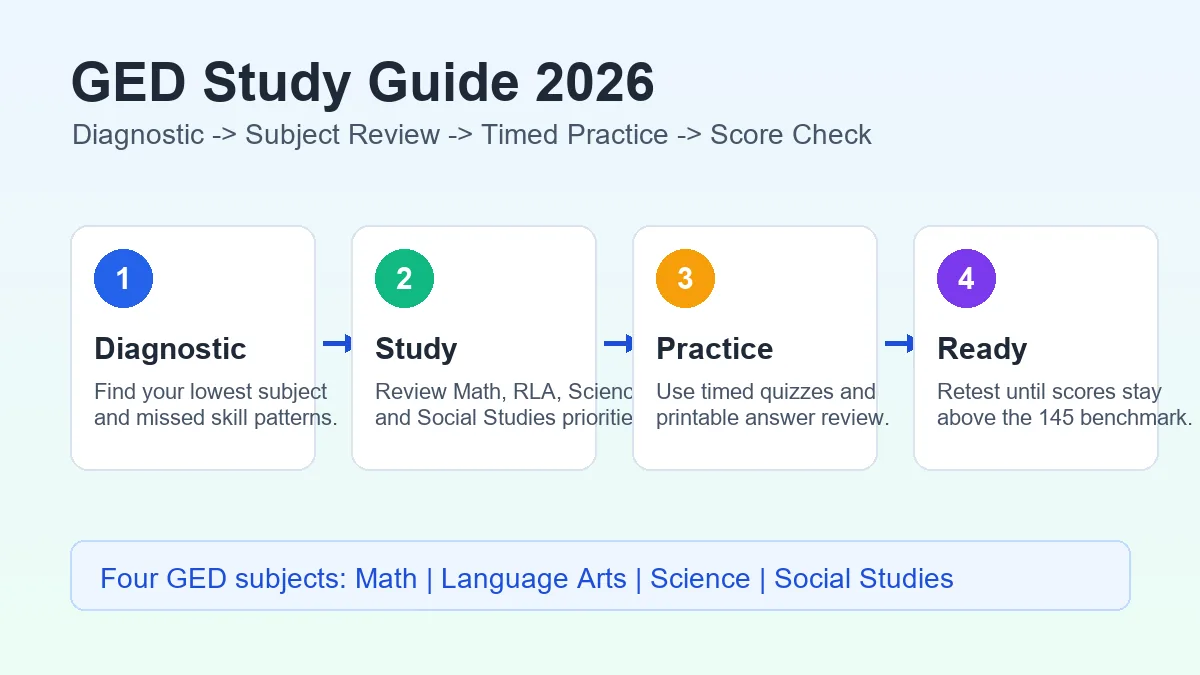
Take one mixed-subject diagnostic test, list the missed skills by subject, study your weakest area first, and retest in short timed blocks. A useful GED study guide should not be only a list of topics. It should help you choose a daily task, review missed answers, compare GED test cost before scheduling, and decide when your practice score is ready for the real exam.
What Is on the GED Test?
The GED exam has four subject tests: Mathematical Reasoning, Reasoning Through Language Arts, Science, and Social Studies. Each subject measures practical high school equivalency skills. The official GED Testing Service sets the passing score at 145 for each subject, so your study plan should track readiness one subject at a time instead of treating the GED as one large test.
| GED Subject | What to Study | Best Practice Link |
|---|---|---|
| Mathematical Reasoning | Algebra basics, quantitative reasoning, geometry, graph reading, data tables, formulas, and calculator decisions. | GED Math Practice Test |
| Reasoning Through Language Arts | Reading comprehension, main idea, evidence, grammar, sentence structure, argument analysis, and essay planning. | GED RLA Study Guide |
| Science | Life science, physical science, earth and space science, experiments, variables, graphs, and evidence-based conclusions. | GED Science Study Guide |
| Social Studies | Civics, U.S. history, economics, geography, source analysis, charts, timelines, and reading historical arguments. | GED Social Studies Study Guide |
Step 1: Take a Diagnostic Before You Read More
The fastest GED study plan begins with evidence. Take a short mixed-subject quiz or a full practice test before building a schedule. A diagnostic score tells you whether you need content review, reading practice, calculator fluency, timing work, or a combination of all four.
Diagnostic Review Checklist
- Score by subject: note which GED subject is below passing or closest to passing.
- Reason for each miss: mark content gap, reading error, calculation error, or timing issue.
- Question type: record whether you missed graphs, passages, formulas, grammar, or evidence questions.
- Retest plan: schedule a short retest only after you review the missed skill, not immediately after seeing the answer.
Step 2: Study the Highest-Impact Skills in Each Subject
A good GED study guide saves time by separating high-value skills from low-value memorization. You do need basic facts and vocabulary, but most GED questions reward reading accuracy, evidence, setup, and applying information provided in the question.
Focus on setup before arithmetic
Practice translating word problems into equations, labeling units, reading graphs, and deciding when a formula applies. Use the GED math formula sheet as a recognition tool, not a memorization-only page.
Example: if a problem gives a room length and width, identify it as area before multiplying numbers.
Use evidence, not opinion
Most reading questions ask what the passage supports. Underline the sentence that proves your answer. For grammar, review sentence boundaries, punctuation, transitions, and clear wording.
Example: choose the answer that matches the author's claim, not the answer that sounds most reasonable outside the passage.
Read data before choosing
Study life, physical, and earth science basics, but spend more practice time on graphs, experiments, variables, and conclusions supported by evidence.
Example: if a table changes one condition, identify the independent and dependent variables before comparing results.
Treat sources like evidence
Review civics, economics, U.S. history, and geography, but practice interpreting maps, charts, political cartoons, timelines, and primary-source excerpts. Use the GED Social Studies study guide when you need a focused source-reading and civics review plan.
Example: match a claim to the source detail that directly supports it instead of relying on memory alone.
Free GED Study Guide Topics to Prioritize
A broad GED study guide should point you to the next concrete skill, not keep every student on the same plan. Use this priority table when you are deciding between a full GED guide, a subject study guide, a printable PDF, or more practice questions.
| Search or Need | Best Current Page | Why It Belongs There |
|---|---|---|
| GED study guide 2026 | This 4-subject guide | It covers the full plan, diagnostic flow, study schedule, and readiness decision. |
| GED science study guide | GED Science Study Guide | Science-specific graph, experiment, and evidence questions need their own focused page. |
| GED social studies study guide | GED Social Studies Study Guide | Civics, source analysis, history, economics, and geography should not crowd the all-subject overview. |
| Free GED study guide PDF | Printable GED practice test PDF | Printable intent needs offline notes, answer review, and a paper-to-online workflow. |
| GED practice books | This guide plus subject pages | Use books for lessons, but use online practice to verify timing and answer explanations. |
30-Day GED Study Plan
Use this plan if you can study about 45 to 90 minutes most days. If your diagnostic scores are far below passing, repeat each week twice. If one subject is already strong, replace some review days with timed practice in your weakest subject.
Week 1: Diagnostic and Math Foundation
Take a mixed diagnostic, then review arithmetic, algebra setup, formulas, graphs, and calculator habits. End the week with a 20-question math quiz.
Week 2: Reading and Language Arts
Practice main idea, evidence, grammar, transitions, and short writing plans. Review every wrong answer by finding the exact passage sentence that proves the correct choice.
Week 3: Science and Social Studies
Alternate science graphs and experiments with social studies sources, civics, economics, and charts. Keep a short list of recurring vocabulary and source-analysis mistakes.
Week 4: Timed Practice and Retesting
Take timed subject tests, review missed questions, and retest only the skills you corrected. Use practice scores to decide which official subject test to schedule first.
How to Know You Are Ready
Because the GED is scored by subject, readiness should also be decided by subject. Do not schedule all four tests just because one score looks strong. Look for repeated passing-range practice, fewer careless misses, and better timing. Before choosing a date, confirm the GED requirements for your age, ID, and state rules. If you want an official readiness signal before scheduling, review the GED Ready practice test guide after you complete your free practice and error review.
If you are deciding how to book test appointments, review how long the GED test takes before choosing one day or split subject dates. Timing stamina is part of readiness, especially for RLA and Math.
| Practice Result | What It Means | Next Step |
|---|---|---|
| Below 145 | You are not consistently at the official passing benchmark yet. | Review missed skills, then retest in short blocks before another full practice test. |
| 145-150 | You are near passing, but small mistakes can still matter. | Build a cushion with timed practice and review your highest-frequency misses. |
| 150+ | You have a stronger readiness signal if the score repeats across more than one practice test. | Consider scheduling that subject after confirming timing and test-day logistics. |
Common GED Study Mistakes
- Reading study guides without testing: practice questions reveal the skills you actually need to fix.
- Retaking tests too quickly: if you retest before reviewing, you measure memory of answers instead of improvement.
- Studying all subjects equally: spend more time where your diagnostic score is lowest or least stable.
- Ignoring timing: untimed accuracy is useful early, but timed practice is needed before scheduling.
- Memorizing facts without evidence practice: GED questions often provide passages, charts, and data that must be interpreted carefully.
How to Combine This GED Study Guide with Practice Tests
Use study time and testing time for different jobs. Study sessions should fix one weak skill. Practice tests should measure whether that fix works under test conditions. If you take test after test without reviewing answer explanations, your score may not move even when you spend more time.
Day 1: Diagnose
Take a 20-question mixed quiz and write down the weakest subject plus the reason for each miss.
Days 2-4: Repair
Study one skill at a time with the subject guide, formula sheet, or printable answer review workflow.
Day 5: Retest
Take a timed subject set and compare the new mistakes with the original diagnostic list.
Official Source Note
Use this independent GED study guide with official information from GED Testing Service, including the GED test subjects overview and the GED Testing Service. Always confirm current scheduling, accommodations, scoring, and state requirements with official GED resources.
GED Study Guide FAQ
Next Step
Start with a diagnostic practice test, then choose one subject to improve this week. Keep your study notes simple: missed skill, reason for the miss, review action, and retest result.