How Long Is the GED Test? Subject Times and Schedule Plan
The full GED test takes about 7.5 hours of subject testing time, but you usually do not need to take all four subjects in one sitting. Use this guide to compare the official time limits, plan breaks, and practice pacing before test day.

Quick Answer: How Long Is the GED Test?
The four GED subjects add up to about 7.5 hours of testing time: Math is 115 minutes, Reasoning Through Language Arts is 150 minutes, Science is 90 minutes, and Social Studies is 70 minutes. Add check-in, instructions, breaks, and travel time if you are taking the test at a center.
If you mean the full preparation period rather than test-day length, use the separate guide to how long it takes to get a GED.
GED Test Time by Subject
The GED is not one single continuous exam. It is four subject tests, and each subject has its own time limit. The number of items also varies by subject and test form; see the GED question-count breakdown for realistic ranges. That matters because a learner who can handle a 70-minute Social Studies test may still need extra pacing practice before the 150-minute RLA test.
| GED Subject | Time Limit | What Usually Makes It Feel Long | Best Practice Page |
|---|---|---|---|
| Reasoning Through Language Arts | 150 minutes | Reading passages, editing questions, and extended response writing. | Language Arts practice test |
| Mathematical Reasoning | 115 minutes | Word problems, calculator decisions, formula use, and multi-step setup. | GED Math practice test |
| Science | 90 minutes | Charts, experiments, short passages, and data interpretation. | GED Science practice test |
| Social Studies | 70 minutes | Source reading, maps, graphs, political cartoons, and civics passages. | Social Studies practice test |
Longest Subject: RLA
Plan your reading and writing stamina around Reasoning Through Language Arts first. A short grammar quiz is not enough practice for the full 150-minute experience.
Shortest Subject: Social Studies
Social Studies is shorter, but it can feel fast because many questions require reading a source before choosing an answer.
Do You Have to Take All GED Subjects in One Day?
No. You can schedule GED subjects separately. Many learners take one subject at a time because it reduces fatigue and makes study planning simpler. A one-day plan can work for a very prepared test taker, but it is rarely the easiest approach for someone still building confidence.
If you are using free practice tests to prepare, schedule the subject where your timed practice score is most stable first. Then use the result to decide whether your next subject should be Math, RLA, Science, or Social Studies.
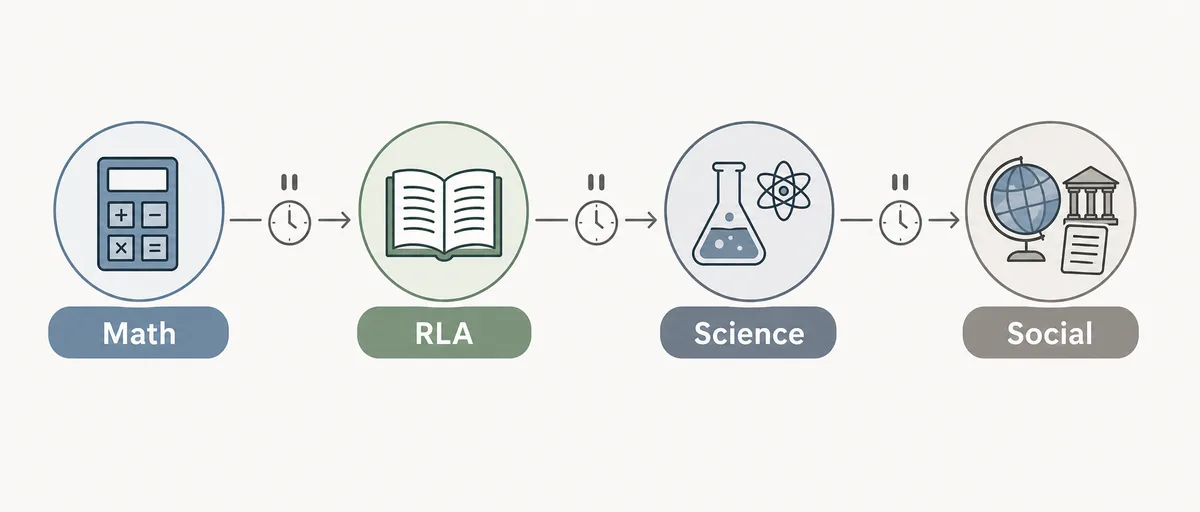
One-Day GED Schedule vs. Split Schedule
The right schedule depends on stamina, transportation, test-center availability, and how even your subject scores are. Use the comparison below before you book appointments.
| Schedule Type | Best For | Main Risk | Practice Before Choosing |
|---|---|---|---|
| All subjects close together | Learners who already score consistently above passing in every subject and have strong test stamina. | Fatigue can hurt later subjects, especially RLA or Math. | Take a full GED practice test and review score drops by section. |
| Two subjects per day | Learners who want momentum but still need a manageable testing load. | Pairing two reading-heavy subjects can drain focus. | Pair a longer subject with a shorter one during practice. |
| One subject at a time | Learners balancing work, family, retakes, or uneven subject readiness. | Preparation can stretch out if you do not set dates. | Use a weekly plan from the GED study guide. |
How Much Time Should You Add for Check-In and Breaks?
| Subject | Official Time | Practical Calendar Block |
|---|---|---|
| Reasoning Through Language Arts | 150 minutes | About 3 to 3.5 hours |
| Mathematical Reasoning | 115 minutes | About 2.5 to 3 hours |
| Science | 90 minutes | About 2 to 2.5 hours |
| Social Studies | 70 minutes | About 1.5 to 2 hours |
These are planning ranges rather than guaranteed appointment lengths. Use the official subject time plus a reasonable check-in and transition buffer, and follow the instructions in your GED account and confirmation email.
The official subject time limit is only part of your day. At a test center, plan extra time for arrival, ID check, locker or personal item rules, instructions, and any scheduled break policy. For online testing, plan time for workspace checks, equipment checks, and possible support delays.
A practical rule is to block more time than the subject limit. For example, a 115-minute Math test should not be squeezed into exactly two hours on your calendar. Give yourself a buffer so transportation, setup, or stress does not become the real problem.
Calendar Buffer Checklist
- Arrive or log in early enough to solve check-in issues calmly.
- Do not schedule work, childcare pickup, or another appointment immediately after the test.
- Eat before longer subjects, especially RLA and Math.
- Bring approved ID and review the current GED.com rules before test day.
- Use the same calculator and scratch-work habits during practice that you plan to use on test day.
How to Practice GED Timing Without Burning Out
You do not need to begin with a full 7.5-hour simulation. Build timing in stages so you can learn from mistakes instead of only measuring exhaustion.
1Start with untimed accuracy
For a weak subject, first learn the question types and explanations. If you rush before understanding the skill, timing practice only teaches you to make mistakes faster.
2Move to short timed sets
Try 10 to 20 questions with a timer. After the set, mark whether each miss came from content, reading, calculation, or pacing.
3Practice the longest subject separately
RLA deserves its own stamina practice because it combines reading and writing. Use GED essay practice to prepare for the extended response before a full timed RLA set.
4Take a full mixed practice test near the end
Once individual subjects are stable, use a full practice test to check transitions, mental fatigue, and score consistency across all four subjects.
Timing Plan by Learner Situation
| Your Situation | Recommended Timing Plan | First Page to Use |
|---|---|---|
| You are just starting | Do short untimed diagnostics, then build one subject at a time. | Free GED practice tests |
| You are close to passing Math | Practice 30-45 minute math blocks, then one full 115-minute math session. | GED math formula sheet |
| Reading fatigue is your issue | Split RLA practice into passage reading, editing, and essay blocks before combining them. | GED RLA study guide |
| You want an official readiness check | Use free practice first, then take GED Ready for the subject you plan to schedule. | GED Ready practice test guide |
FAQ
How long is the GED test total?
The four subject time limits add up to about 7.5 hours. Your real appointment day may be longer after check-in, instructions, breaks, and transitions.
Which GED test takes the most time?
Reasoning Through Language Arts is the longest subject at 150 minutes. It usually needs the most stamina practice because it includes reading and extended response writing.
Can I take the GED test in parts?
Yes. GED subjects can be scheduled separately. This is often the best approach if your practice scores are stronger in some subjects than others.
How long should I study before taking a timed GED practice test?
Start timing once you understand the basic question types. If you miss most questions because of content gaps, study first. If you miss because you run out of time, timed practice is the right next step.
Is GED Ready the same length as the real GED test?
GED Ready is an official readiness practice test for a subject, but you should check GED.com for the current details before buying or scheduling. Use free practice first, then use GED Ready when you want an official readiness signal.